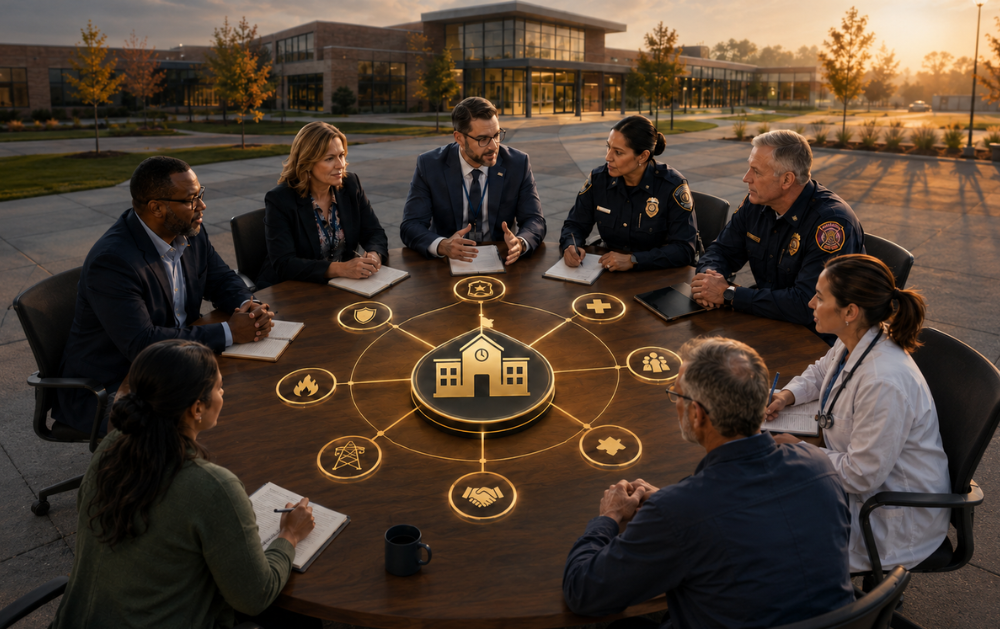
A comprehensive safety program is not sustained by one committee, one plan, or one annual meeting. It is sustained by a connected system of people who each understand their role, and who have built trust before an emergency occurs. |
The Federal Starting Point
Before officially going offline in September 2025, the Readiness and Emergency Management for Schools Technical Assistance Center’s Building Blocks to School Safety toolkit outlined a six-step planning process for developing high-quality school emergency operations plans. Step 1 is fundamental: form a collaborative planning team. The guidance calls for a core team that brings together district-level leaders, school personnel, community partners, first responders, and others who can contribute different professional perspectives to emergency planning.
That is sound guidance. Collaboration should be the starting point because no single office, discipline, or individual possesses all the knowledge necessary to prevent, prepare for, respond to, and recover from the full range of threats and hazards facing a school community.
But after nearly four decades working in K–12 school safety, law enforcement, risk management, security, and emergency preparedness, I believe districts must take this first step further. One collaborative planning team may be sufficient to develop an emergency operations plan. It is rarely sufficient to sustain a comprehensive school safety, security, and emergency preparedness program across an entire district.
Why Collaboration Often Struggles
Many school districts recognize the value of collaboration, yet still struggle to create groups that remain active, candid, and productive. The obstacle is usually not a lack of well-intentioned people. It is the absence of structure, purpose, ownership, and consistency.
Some groups are assembled only to complete a plan, respond to a mandate, or prepare for an exercise. Once that immediate task is finished, meetings become less frequent, participation declines, and relationships weaken. Other groups become too large or too general. Everyone is invited, but no one is certain what decisions the group owns or what work must occur between meetings. In some settings, politics or concern about liability prevents honest conversations about vulnerabilities, lessons learned, and needed improvements.
Sustainable collaboration requires more than a distribution list. It requires a defined mission, the right people, a reliable meeting cadence, meaningful work, and a leader who is willing to champion the cause over time.
School Safety Is Local
The strongest school safety programs are built with the people who understand the community, the campuses, the students, the available resources, and the realities of local response. A major incident at a neighboring school district, private school, college, hospital, or community facility will not respect jurisdictional boundaries. It may affect transportation, communications, family reunification, hospital capacity, public information, law enforcement resources, and the daily operations of every nearby school system.
Districts with strong working relationships among schools, law enforcement, fire services, emergency medical services, hospitals, mental health professionals, public health agencies, and other partners already possess something no generic checklist can provide: shared local knowledge and trusted relationships. Those partnerships help a district identify solutions that fit its culture and operating environment.
This does not mean an outside consultant can never add value. An experienced, independent, vendor-neutral consultant can provide objective assessment, specialized expertise, and a fresh perspective. A consultant should strengthen local capacity, not substitute for it.
Look Beyond the Traditional Partners
When many leaders hear the term community partners, they immediately think of law enforcement and fire services. Those relationships are essential, but a complete partnership network must go deeper. District leaders should examine the entire city, neighboring jurisdictions, county, and, when appropriate, state-level resources to identify who may influence or support school emergency operations.
The broader network may include:
- Educational partners: neighboring public school districts, county offices of education, private and nonpublic schools, charter schools, and colleges or universities.
- Health and human-services partners: hospitals, emergency medical services, public health, behavioral-health providers, social workers, child-serving agencies, and the American Red Cross.
- Infrastructure and utility partners: electric, gas, and water providers, along with wireless carriers and communications providers.
- Government and community partners: city and county emergency management, elected officials, community-based organizations, faith-based partners, and other agencies with a role in preparedness or recovery.
Wireless carriers are a good example of an often-overlooked partner. They can help districts understand what occurs when networks are overloaded or service is interrupted, and they may be able to provide deployable communications assets during a significant emergency. Electrical, gas, and water providers may not be needed at every discussion, but when an incident affects essential services, an established relationship can save valuable time.
Keep the invitation open even when a partner cannot attend every meeting. Collaboration is built through continuity. A minimum quarterly cadence provides a practical rhythm for maintaining relationships, sharing developments, and conducting focused planning or exercises.
Who Will Champion the Cause?
Every successful collaborative effort needs a credible champion. The person chairing the group does not need to be the highest-ranking official, but must have the trust, access, judgment, and persistence to move the work forward. In my experience, the long-term strength of a collaborative group often depends on several qualities:
- Investment of time. The chair must prepare useful agendas, maintain contact between meetings, follow through on commitments, and continually create value for participants.
- Employment longevity. Relationships mature over years. A leader who can remain connected to the work helps preserve institutional knowledge and continuity through changes in personnel.
- Group and team awareness. The chair must understand how different disciplines operate, where tension may exist, and how to keep a diverse group focused on shared outcomes.
- Interpersonal skills and emotional intelligence. Trust grows when participants feel heard, respected, and safe enough to raise concerns without being dismissed or embarrassed.
- A systems-thinking perspective. The leader must see how school operations, public safety, mental health, healthcare, infrastructure, communications, families, and community recovery affect one another.
- Relevant safety and security experience. The chair needs enough practical knowledge to recognize gaps, ask meaningful questions, and translate conversation into action.
The Champion as a Change Agent
Forming a group is an administrative act. Sustaining one is an act of leadership. The champion must create a sense of urgency without using fear, pull together a credible guiding group, and communicate a clear vision for what collaboration is intended to accomplish.
The leader must also identify and remove obstacles, empower participants to contribute, and remain consistent when enthusiasm naturally rises and falls. New collaborative groups require time to develop their identity and culture. They must be nurtured, shaped, and allowed to become increasingly self-directed.
Bolman and Deal, in their book Reframing Organizations, have noted that self-directed teams can produce stronger results and higher morale than groups operating under a traditional top-down model. That principle is particularly relevant to school safety. The most effective collaborative groups are not audiences waiting for one person to deliver answers. They are working teams whose members share responsibility, expertise, and ownership.
EPIC: A Regional Model Built on Trust
In 2014, I founded the Emergency Preparedness Interagency Collaborative (EPIC) to bring together a broad cross-section of disciplines for the 50,000-foot conversation about school emergency preparedness. I chaired the collaborative for 11 of its first 12 years. What began as a small group grew into a network of approximately 140 professionals on the distribution list, representing roughly 20 agencies and organizations.
EPIC’s reach has included seven unified school districts, higher education institutions, cities, private schools, utility companies, law enforcement, fire services, healthcare and public health partners, and the American Red Cross. Quarterly meetings and multi-agency exercises created the consistency needed for partners to learn how one another operates, identify shared gaps, and build trust before a crisis.
That collaboration produced more than conversation. It generated new working relationships and more specialized groups. The School and Hospital Alliance for Response in Emergencies (SHARE) grew from an EPIC hospital-liaison effort to focus on school-hospital coordination, patient tracking, reunification, and family information needs following a mass-casualty event. This is an important lesson: a healthy collaborative ecosystem should be capable of generating new groups when a distinct operational need emerges.
One District, Multiple Groups, Distinct Purposes
A regional group such as EPIC provides the broad external perspective, but districts also need internal and specialized groups closer to day-to-day operations. One large committee cannot effectively conduct strategic regional planning, examine confidential incidents, test school-site procedures, engage parent leaders, and address employee safety concerns in the same meeting. The participants, level of confidentiality, authority, and desired outcomes are different.
A mature district should consider a connected structure that includes the following groups:
- A regional interagency collaborative. This is the 50,000-foot group of school systems, first responders, healthcare partners, government agencies, utilities, and community organizations. Its work centers on shared threats, cross-jurisdictional coordination, communications, resources, and large-scale exercises.
- An internal district emergency and safety partnership. Include a representative from every school and major district department. Meet at least quarterly to examine emergency operations plans, discuss site-level needs, identify gaps and challenges, and conduct tabletop exercises. These are the boots-on-the-ground conversations in which every school has a voice.
- A confidential law-enforcement and district leadership forum. Create a protected confidential setting for district leaders, school resource officers, and police partners to examine local incidents and relevant events from around the county, state, and nation. The value is an honest, operational conversation focused on lessons and improvement, not politics or public performance.
- A school-hospital and healthcare coordination group. Mass-casualty incidents create complex patient-tracking, notification, reunification, and family-information challenges. A focused group such as SHARE allows schools, hospitals, EMS, and related agencies to develop solutions that a general committee cannot address in sufficient depth.
- A parent-leader safety forum. PTA presidents and other parent representatives should understand the district’s emergency preparedness foundation, safety systems, and security framework. Informed parent leaders can explain procedures accurately, identify community concerns early, and help build trust at individual schools and at the district level.
- Labor and district safety committees. Union representatives and employee stakeholders bring essential knowledge about working conditions, supervision, training, injuries, and operational hazards. Traditional district safety committees may often focus on workplace injuries and compliance, but they should also be connected to the district’s larger safety foundation.
Parents and Elected Leaders Belong at the Table
Parent groups are among the most valuable and underused assets in a school district. I have seen parent leaders bring forward safety and security ideas that initially gained little traction, but remained part of the conversation until the timing and conditions were right for implementation. Several meaningful initiatives can begin this way, not as top-down directives, but as community ideas refined through sustained dialogue.
School board members should also be invited into the appropriate high-level collaborative setting. Board members regularly serve as liaisons to outside organizations and report back during public meetings. When they understand the district’s safety, security, and emergency preparedness foundation and partnership network, they can communicate with greater confidence and clarity, support responsible priorities, and explain why sustained collaboration matters. Their presence should strengthen governance and understanding without turning operational discussions into political events.
From Meetings to Measurable Value
A collaborative group should not exist merely because it has always existed. Each group should have a written purpose, defined membership, appropriate confidentiality expectations, a regular cadence, and a connection to the district’s broader safety, security, and emergency preparedness structure. Meetings should produce value through shared training, tabletop exercises, plan review, after-action discussion, resource mapping, problem solving, and clearly assigned follow-up.
District leaders should periodically ask: Are the right people at the table? Are participants able to speak candidly? Does the group understand what it owns? Are recommendations reaching decision-makers? Are lessons from incidents and exercises changing policy, training, facilities, communications, or practice? If the answer is no, the group may need to be redesigned, not simply scheduled more often.
Build the Foundation Before the Framework
Emergency operations plans, security systems, training programs, communications tools, and response protocols are all important parts of a district’s safety framework. But the framework will not remain strong if it is built on a weak collaborative foundation. Without trusted relationships, clearly understood roles, and an established process for making decisions together, even sophisticated systems can begin to resemble a house of cards.
The work is not complete when a district forms one planning team. That is the beginning. The stronger approach is to create multiple collaborative groups, each designed around a unique purpose and connected to the same districtwide vision. One group sees the regional system. Another hears directly from school sites and departments. Another creates space for candid law-enforcement coordination. Another solves the difficult school-hospital and reunification challenges. Parent leaders strengthen communication and trust. Labor and safety committees bring the experience of employees into the work.
Together, these groups create depth, redundancy, institutional knowledge, and shared ownership. They allow concerns to surface in the right setting, bring the right expertise to each problem, and prevent the entire program from depending on one person, one committee, or one annual exercise.
THE CALL TO ACTION Do not ask one collaborative team to carry the full weight of your school safety, security, and emergency preparedness program. Build a system of groups, each with the right people, the right purpose, and the courage to address the right concerns. Connect them through consistent leadership and a shared mission. That is how collaboration becomes capacity, how planning becomes practice, and how safer schools are built on foundations strong enough to stand the test of time. |
About the Author
Stephen Bucheli Bayne, Ed.D., is the Principal Consultant at Framework Synergy Solutions LLC, a K–12 school safety, security, and emergency preparedness consulting firm. His work is informed by nearly four decades of public-education experience spanning school law enforcement, risk management, emergency preparedness, security operations, district leadership, training, and expert-witness consultation.
Reference
Readiness and Emergency Management for Schools Technical Assistance Center, Building Blocks to School Safety: A Toolkit for K–12 Schools and School Districts for Developing High-Quality School Emergency Operations Plans.